The winners of the Bird Photographer of the Year 2026 competition have been announced, revealing an extraordinary collection of photographs that capture birds in flight, underwater, in cities, and in some of the most remote landscapes on Earth.
More than 24,000 images were entered in this year’s competition. The overall title went to British photographer Henley Spiers for an underwater photograph of a Northern Gannet, while awards were also presented across categories including bird behaviour, portraits, conservation, urban birds, creative photography, and young photographers.
Bird Photographer of the Year 2026: Overall Winner
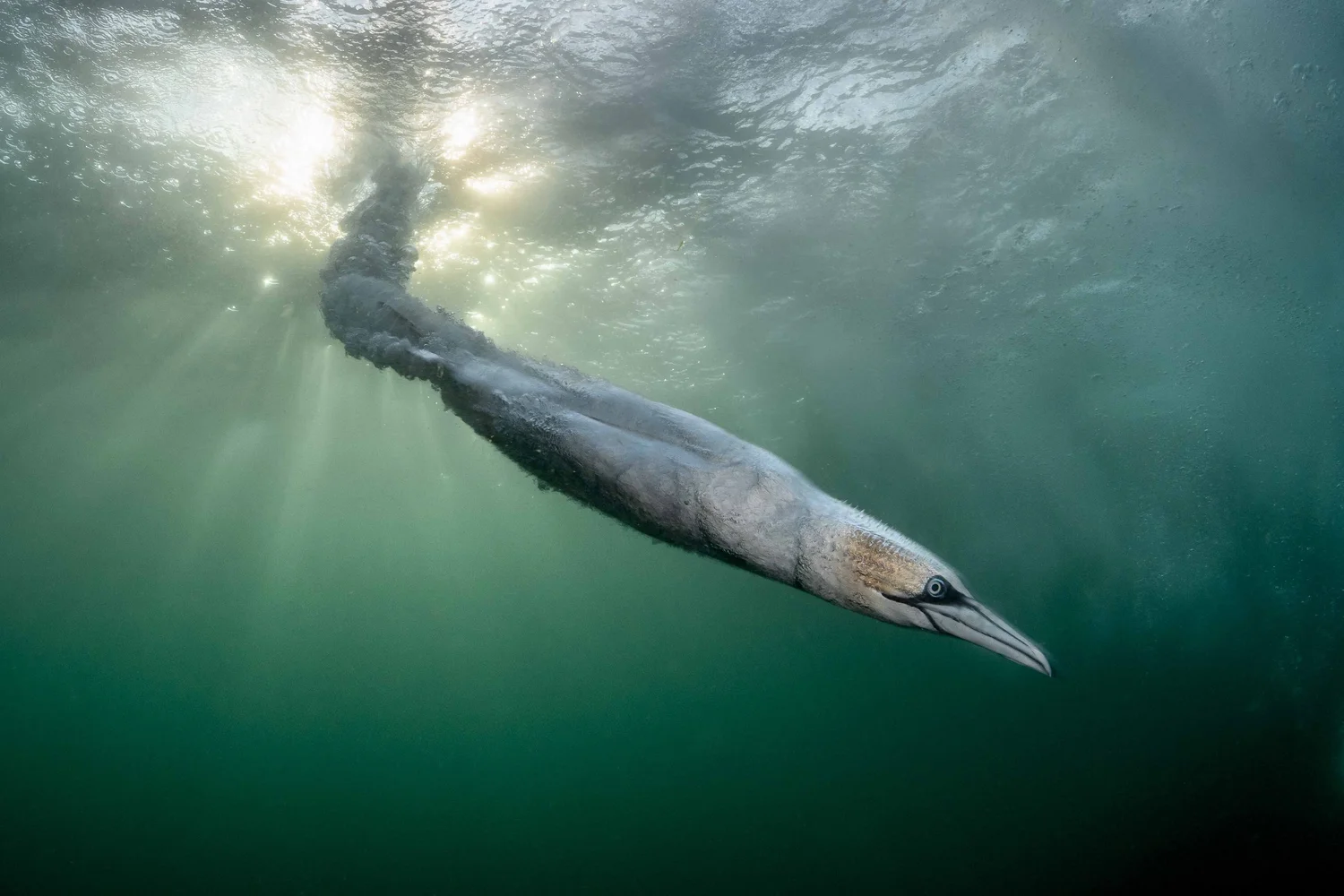
The title of Bird Photographer of the Year 2026 was awarded to Henley Spiers from the United Kingdom for his photograph “Sunball Rocket.”
The image shows a Northern Gannet (Morus bassanus) underwater, moments after the bird has plunged through the sea surface in pursuit of fish. Seen from below, the gannet appears to shoot out from the bright disc of sunlight above it, its streamlined body surrounded by bubbles.
Northern Gannets are remarkably well adapted to plunge-diving. Before hitting the water, they fold their long wings against their bodies and enter the sea almost like a spear. Their anatomy includes adaptations that help protect them from the enormous forces generated during these dives.
Spiers’ photograph also received the Gold Award in the Birds in the Environment category. As overall winner, he received the competition’s £3,000 grand prize.
Young Bird Photographer of the Year 2026
The Young Bird Photographer of the Year title went to 16-year-old Parham Pourahmad from the United States.

His winning photograph, “Moonlit Night,” depicts a Great Horned Owl framed against a full moon. Rather than relying on a conventional close portrait, the photograph uses the moon and surrounding darkness as important parts of the composition, turning the owl into part of a much larger nocturnal scene.
The competition also included separate categories for younger photographers aged 12–14 and 11 and under.
In the 12–14 category, Germany’s Paula Czaeczine won Gold with “Acrobat of the Skies,” showing a Red-necked Phalarope stretching upwards and fluttering above the water while feeding on insects.
Best Portrait
The Gold Award for Best Portrait went to Thomas Deliberto of the United States for “Radiant.”

The photograph features a male Greater Sage-Grouse during its elaborate courtship display. Male sage-grouse gather at traditional display grounds known as leks, where they spread their tails and inflate specialised air sacs on their chests to attract females.
Deliberto’s photograph concentrates attention on the bird’s remarkable shape and plumage, turning an already spectacular natural display into a carefully composed portrait.
Silver went to Volker Widmann of Germany for “Sunset Puffin,” while David Stowe of Australia received Bronze for “Tiny Dancer.”
Birds in the Environment
Henley Spiers’ overall-winning “Sunball Rocket” took Gold in Birds in the Environment, a category intended to show not only the bird itself but also its relationship with its habitat.
The Silver Award went to Norwegian photographer Åsmund Keilen for “Majesty,” in which a Golden Eagle passes across the face of the moon above a mountainous landscape.
Romain Barats of France took Bronze with “Back to Fishing,” an underwater photograph featuring Gentoo Penguins in Antarctica.
These photographs demonstrate why habitat can be just as important as the bird in wildlife photography. Instead of isolating their subjects, the photographers use sea, sky, mountains, ice, and light to provide context.
Bird Behaviour
The Bird Behaviour Gold Award went to Australian photographer Donald Chin for “I’m Keeping Everyone Dry.”

The image captures a young Tawny Frogmouth spreading its wings during rainfall, apparently sheltering its siblings beneath them. The combination of behaviour and timing transforms the photograph from a simple portrait into a small story about the birds.
British photographer Mark Carwardine won Silver with “Spread Eagle,” while Austria’s Bernhard Schubert received Bronze for “Kleptoparasitism,” showing frigatebirds competing over food.
Birds in Flight
Photographing a fast-moving bird in flight remains one of the most technically challenging forms of bird photography.
The 2026 Gold Award went to Sweden’s Ivan Sjögren for “Eye-to-Eye with a Short-Eared Owl.” The photograph shows a Short-eared Owl flying over the salt marshes of Canada’s Fraser River Delta.

Silver went to Alex Pansier of the Netherlands for “Patterns,” a photograph filled with flying guillemots, and Bronze went to Patryk Kurc of Poland for “Lord of the Reedbeds,” featuring a Bittern taking flight.
Black and White
The winner of the Black and White category was Indian photographer Rahul Sachdev with “An Ostrich Horizon.”

Monochrome wildlife photography removes much of the information supplied by colour, forcing the photographer to rely more heavily on shape, contrast, texture, and composition.
The Silver Award went to Raoul Slater of Australia for “Grass Tree,” and Bronze to Julian Terreros-Martin of Spain for “Promenade Preening.”
Urban Birds
Bird photography does not require travelling to untouched wilderness. The Urban Birds category focuses on species sharing spaces created or heavily modified by humans.
Italian photographer Gianluca Damiani won Gold with “Alter Ego.” The photograph creates a humorous visual connection between a real gull and a painted image of a gull on an urban wall.

Romain Barats won Silver with “Deception’s Hope,” while Spain’s Julian Fernandez Quilez received Bronze for “The Window of Dreams.”
The category is particularly interesting because it demonstrates how adaptable many bird species have become. Buildings, streets, harbours, artificial lights and other human structures can all become part of a bird’s environment—and part of the photograph.
Creative Perspectives
Norwegian photographer Åsmund Keilen won the Creative Perspectives category with “Sundance.”
The category encourages photographers to experiment with techniques such as unusual compositions, intentional motion, multiple exposure and abstraction rather than simply documenting a species as clearly as possible.
Henley Spiers added another award to his 2026 results by taking Silver with “Turbulence,” while Julian Łoziński of Poland received Bronze for “Grebe Impression.”
Conservation Photography
Some of the most important photographs in Bird Photographer of the Year are not necessarily the most beautiful.
The Gold Award in Conservation (Single Image) went to American photographer Kent Stuart for “Not a Good Day Fishing.” It depicts a Great Blue Heron entangled with fishing line and a float around its bill, showing one of the dangers discarded fishing equipment can create for wildlife.
France’s Yann Bigant won Silver with “Birds in the Red,” documenting wild birds being sold in Cambodia, while Italy’s Luca Eberle received Bronze for “Discarded Evidence.”
A separate Conservation Award went to British photographer Conrad Dickinson for a photographic series examining the persecution of Hen Harriers in England and the conflict surrounding grouse moor management.
Best Portfolio
The 2026 Best Portfolio Award was won by Canadian photographer Liron Gertsman for his series “Fabulous Frigatebirds.”
Frigatebirds are unusual seabirds. Despite spending much of their lives above the ocean and feeding on marine prey, their feathers are poorly suited to prolonged contact with water. They are famous for their huge wings, forked tails and the bright red throat pouch inflated by males during courtship.
Gertsman’s portfolio documents several sides of their lives, from aerial behaviour to courtship displays and close studies of their plumage.
More Than Beautiful Bird Photos
Bird Photographer of the Year has gradually become more than a competition for technically perfect wildlife photographs. The winning images cover traditional portraits, behavioural observations, experimental photography and conservation stories.
That range is especially visible in the 2026 results. A Northern Gannet becomes an underwater projectile, an owl is reduced to a silhouette against the moon, a city gull appears beside its painted alter ego, while an entangled heron illustrates the consequences of human activity.
Competition director Will Nicholls also highlighted the importance of genuine wildlife photography at a time when AI-generated imagery is becoming increasingly common, describing the winning photographs as records of real encounters requiring patience and a connection with nature.
The competition says that more than £5,000 from the 2026 edition is being donated to Birds on the Brink, an organisation that supports grassroots bird-conservation projects around the world.
For birdwatchers, the winners are a reminder that memorable bird photography does not always depend on finding the rarest species. Behaviour, light, habitat, timing and an unusual perspective can transform even a familiar bird into an extraordinary photograph.