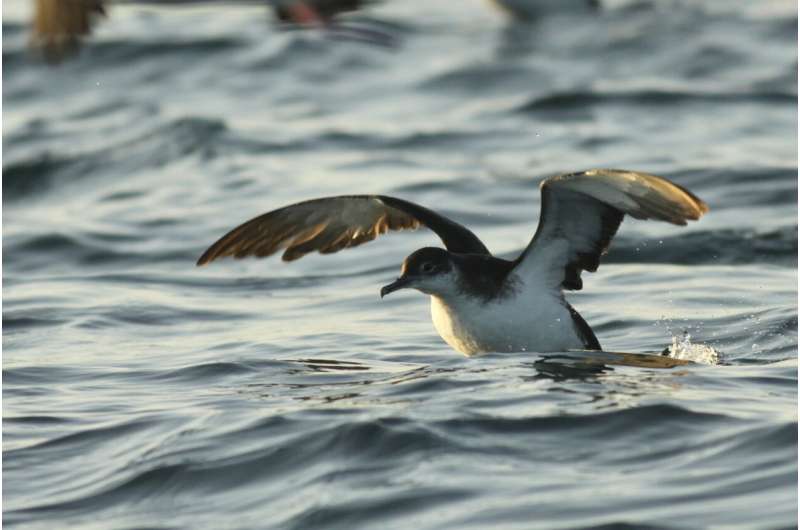
Long-distance flights across the Atlantic can desynchronise seabirds’ internal clocks from local time, potentially disrupting the way they navigate by the sun, according to a study led by Oxford University and published in Science.
The finding points to a bird version of jet lag. Like humans, seabirds possess biological clocks that help coordinate daily activity with the changing light–dark cycle. When a bird travels rapidly across several time zones, that internal schedule may not immediately match the time of day at its new location.
That mismatch matters because the sun is an important source of directional information for many birds. Its position changes predictably through the day, allowing a bird with a functioning time sense to interpret where the sun is in the sky. If the bird’s internal clock is out of step with local time, the same solar position could be interpreted as indicating a different direction.
Predictable errors
The study reported that seabirds affected by long-distance travel made predictable navigation errors when relying on the sun. The result does not mean that every bird will become lost after crossing the Atlantic, nor does the summary establish how long the disruption lasts or how birds compensate for it.
Instead, the work highlights a potential cost of rapid movement across time zones. Seabirds often travel over vast ocean areas, where there may be few visual landmarks. A small directional error, repeated over a long journey, could alter the route an animal takes or the place where it arrives.
Why the result matters
The research adds to understanding of how animal navigation depends on the interaction between behaviour and physiology. It also provides a reminder that navigation systems are not simply external “maps”: they rely on internal timing as well as environmental cues.
Because the result comes from a study of navigation under conditions involving long-distance travel, it demonstrates an association between clock disruption and directional errors rather than proving that all effects of transoceanic flight are the same in every seabird.
Source: Original report.