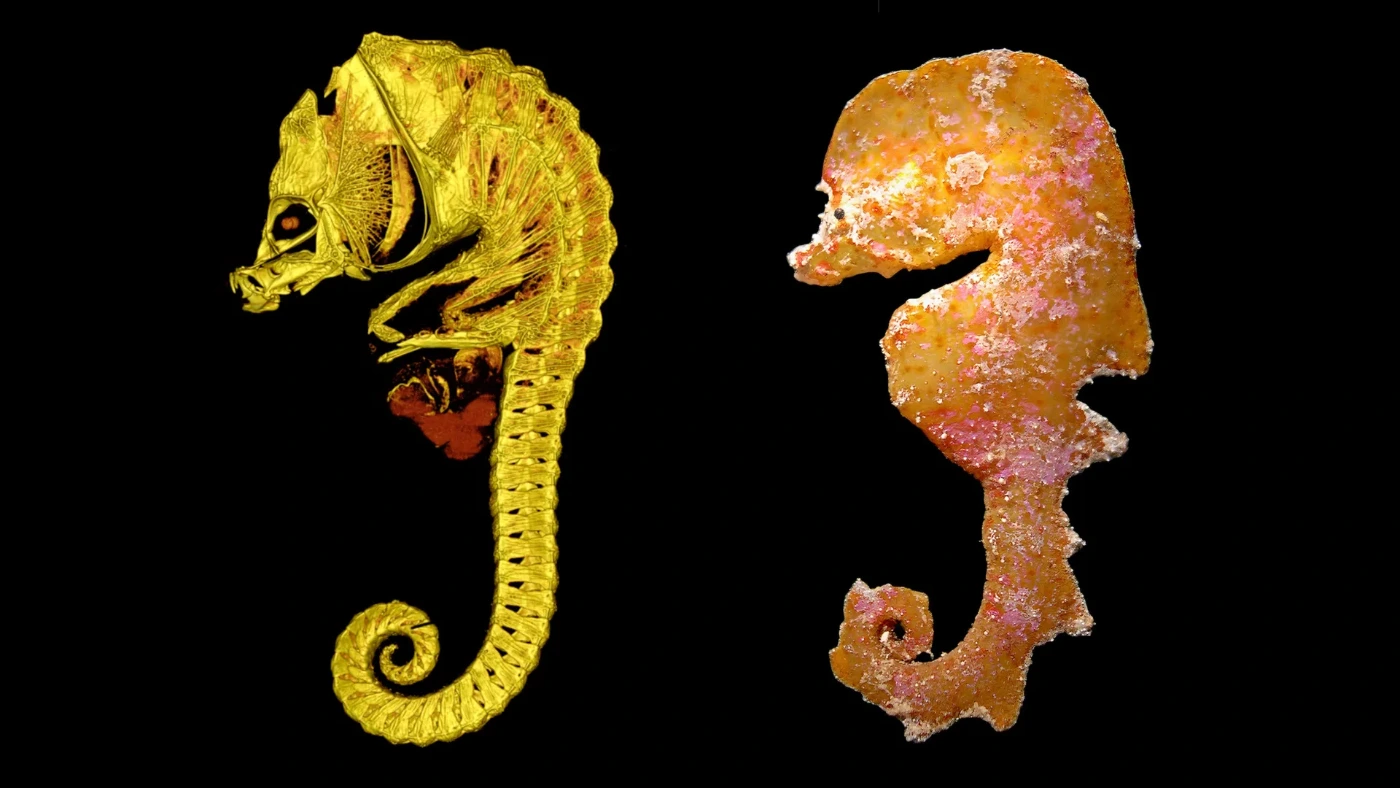
Three mysterious deep-sea fish that look remarkably like seahorses have been identified as members of a separate evolutionary group, revealing that nature has independently produced the unusual seahorse body shape more than once. Nicknamed “sea muppets,” the elusive fish are known from just seven preserved specimens, and none has ever been observed alive.
The discovery concerns a small group of fish from the deep reefs of southern Australia. Its newly described member, Australyichthys aegis, has been given the common name helmethead sea muppet because of the distinctive dome-shaped crest on its head. Its two relatives are the bullneck sea muppet, A. minotaur, and the paradoxical sea muppet, A. paradoxus.
A resemblance that concealed a different identity
At first glance, these fish appear to share the defining features of seahorses: downward-bending heads, grasping curled tails and, in males, enclosed pouches for carrying developing young. Their appearance had previously led scientists to classify them within the seahorse genus Hippocampus.
However, researchers investigating the specimens found important differences beneath their familiar exterior. Because the preserved fish were exceptionally rare, the team avoided destructive dissection and instead used micro-computed tomography, or micro-CT, to create detailed three-dimensional models of their skeletons.
The scans revealed that the fish lacked two characteristic seahorse features: a rigid framework of fused bony plates supporting the belly and a bony head structure known as a coronet. Instead, they possessed a different arrangement of internal bones.
Genetic evidence supported the anatomical findings. DNA from the single specimen suitable for sequencing placed Australyichthys outside the true seahorses, on the evolutionary branch closest to them.
Evolution’s recurring solutions
The findings provide an example of convergent evolution, the process through which unrelated evolutionary lineages independently develop similar physical characteristics. In this case, the seahorse-like combination of body shape, gripping tail and reproductive pouch appears to have evolved separately within the same broader fish family, Syngnathidae, which also includes pipefishes, pipehorses and seadragons.
The specimens were accidentally collected in fishing trawls and scientific dredges from depths of approximately 50 to 125 metres. They represent around 65 years of scattered discoveries along more than 2,500 kilometres of coastline, with no known collection in nearly two decades.
Their designation as lost species does not mean they are extinct. Rather, it highlights how little is known about life in deeper reef habitats. Targeted surveys could help researchers locate living populations and investigate how these unusual fish evolved.
Source: Original report.